60+ Lessons I Learned My First Year as a Founder
7 MIN READBEN KATZ
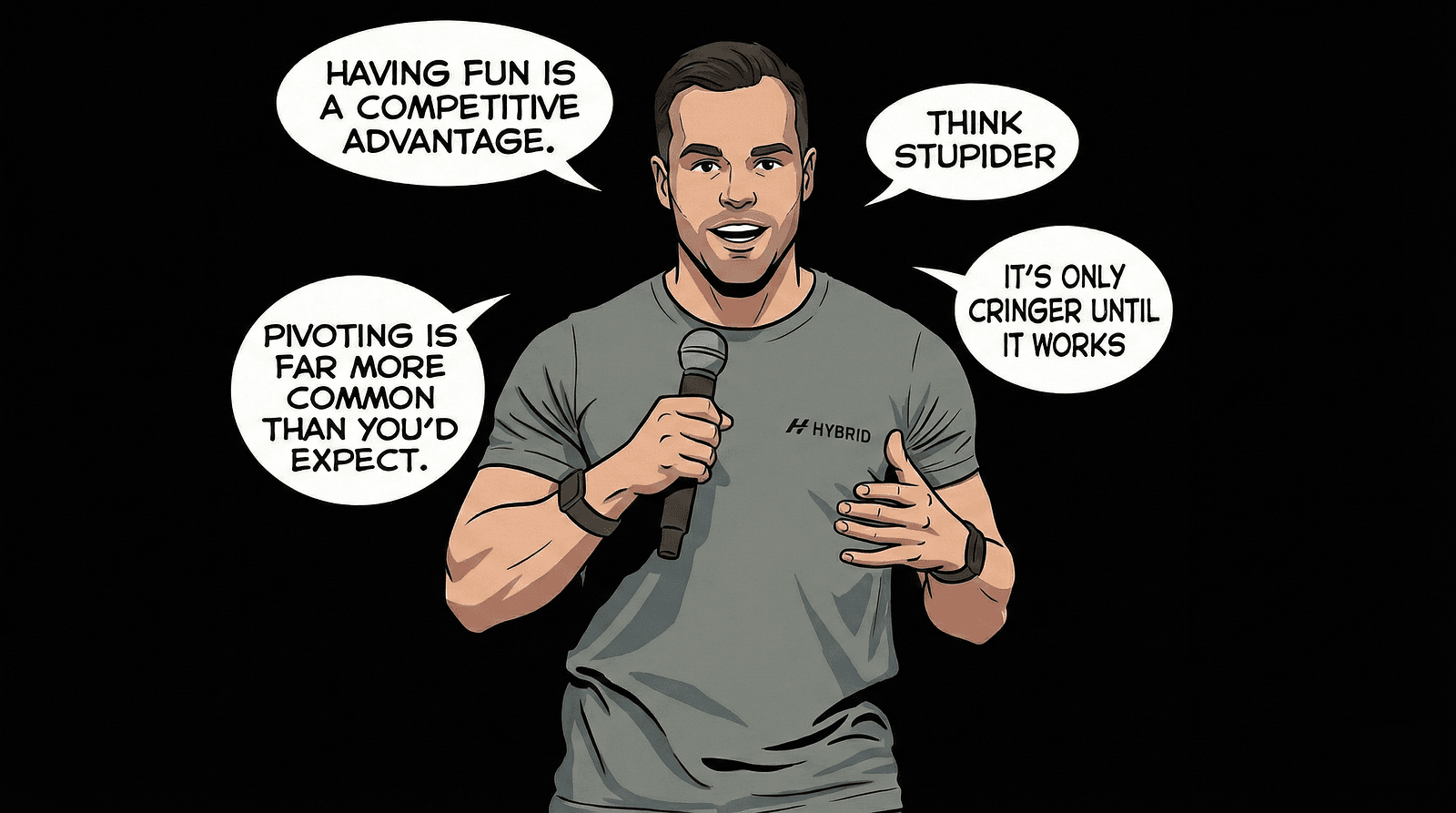
- Having fun is a competitive advantage. It’s harder to kill a team that loves what they’re doing.
- Being a founder is oscillating between “what the hell am I doing” and “we are so back” repeatedly, forever.
- Nobody really know what they’re doing. Everyone is just testing, iterating, and trying to figure it out. No matter what their outward presence/social media says.
- Startups are more likely to commit suicide than get murdered. Said differently, you’re more likely to get frustrated that nothing is working and quit than run out of money.
- You can and should just do things, you don’t need anyone’s permission.
- Think stupider. Stop overcomplicating things.
- Bias to action, always.
- Beware procrastination that feels productive. There are a lot of ways to “play founder” that are performative without being value accretive to your business. Do not do those things.
- Life balance matters. It’s better to work 10–12 hour days and not burn out vs. 15 hour days and burn out. It’s a long game.
- As a founder you have to be making content. Being authentic makes that content much better.
- Everyone’s business looks like it’s crushing on social media. Most of them are not.
- The best way to network is to do something interesting and talk about it on the internet. People will come to you.
- It’s only cringey until it works. Embrace the cringe and move past it.
- Co-founder relationships are like a marriage. Be very careful in who you choose to partner with and structure things intentionally.
- Investors are -1s, 0s, 1s. You will never know who the 1s are ahead of time. Optimize for 0s and avoiding -1s, and you’ll get a few 1s along the way.
- VCs are like someone that sits courtside at a lot of basketball games. They know the players, the rules, and can comment intelligently on the game. That does not mean they can coach the team. Some can because they have the relevant experience (former founders, true specialization in one industry, etc.) but most cannot.
- Fundraising pre-traction is very difficult.
- It takes a lot of investor calls to raise money. As a datapoint, we had >130 first calls before we finished our raise.
- Fundraising is exhausting. Imagine being in back-to-back 30 minute interviews for 10+ hours a day and weeks on end. That’s what it feels like.
- You need to articulate how it gets really really big. VCs operate on the power law. They know most investments go to $0 and need a few BIG hits to make the fund work.
- Related to the above, your GTM plan needs to be flushed out when you fundraise and you need to be able to speak intelligently to it.
- At the earliest stages VCs are investing in you, not your idea. They know things do not go according to plan. They are investing in your team’s ability to execute.
- If you’re in consumer, investors will think about whether they personally would use your product. There will always be a subconscious bias. Keep this in mind with who you target and how you pitch.
- It’s better to be aligned with an investor on operating procedure (communication cadence, etc.) than take misaligned money.
- A deal is never done until it’s done. People back out of things all the time.
- Ask for what you want or you will not get it. Don’t let an investor call end without asking them point blank if they want to invest.
- Pivoting is far more common than you’d expect. Do not be ashamed to do it.
- Obsess over the customer experience. Product is everything. It needs to “just work”.
- Speed to respond to customers is a superpower. It can turn a bad experience into a good one, and can earn you long-term evangelists.
- In consumer, you will never please everyone. It’s impossible. Don’t even try to do it.
- In the earliest days, manually onboarding users yourself is highly valuable. It helps you better understand your users, their pain points, motivations, etc. and it also helps you build direct relationships with them.
- Referral programs only work if people love the product.
- Founding member programs are a fantastic way to get your first users. Structure it something like this: people have to apply to be a founding member, only accept a certain number. Founding members pay a one-time fee for lifetime access, get other perks, swag, and in a group chat with the founding team to help give feedback and develop the product.
- If you’re building a consumer app, either start as free or paid. Freemium can come later. You want to focus on providing value in general and finding PMF, not whether that value goes before or after a paywall.
- Launch faster than you think. You will never feel ready. If you’re not embarrassed by your first version, you waited too long.
- For mobile apps, App Store pre-orders are powerful if leveraged correctly. Strong positive signal to the app store ranking algorithm if you launch and have a bunch of downloads on day one.
- Consistency compounds. It matters across all things. Product updates, socials, etc. Be consistent.
- Clearly define who your target persona is and who it is not. Get specific. Use someone you know personally to embody the persona if you can.
- If you don’t personalize a cold email it will not get a response. Take the time to make it personalized if you want any shot at getting a response.
- Lead magnets are a great form of organic marketing. Give away something tangential to your product that your target market wants for free, but capture emails as part of the flow. Then use that to put them in a marketing funnel.
- Use AI to solve problems in new ways, not as a gimmick. If AI is not the best way to solve a problem, don’t use AI to solve it.
- Automatically populate user metadata in support tickets. First name, user ID, app version. The bare minimum that helps you debug the issue without having to ask them for the things you need to do so.
- The best founders know where to cut corners. Speed is everything and cutting corners helps with speed — but they need to be the right corners.
- The worst AI will ever be is how good it is today. Stay lean and efficient and your team will get increasingly more efficient and capable with the tools that are coming to market.
- As a founder, you are really a salesman. Your job is to sell, always. Sell customers on your product, sell investors on your business, sell marketing partners on your brand, etc. Remember this, and lean into the sale.
- Narrative matters. Think carefully about the narrative behind your fundraising decks, sales pitches, marketing campaigns, etc.
- LinkedIn can be a sneakily good channel for organic content. It has far more content consumers than content creators, so good content stands out.
- You can talk about what you’re building without fully “building in public” and disclosing all your metrics.
- .com domains are king.
- Before you start blasting emails out to your email list, look up IP warming. You do NOT want to end up in email jail.
- Having a community of other entrepreneurs is extremely valuable. For advice/troubleshooting, intros, and just general sharing of strategies, tactics, etc.
- You will get a surprising number of offers to work for free. Keep in mind that it’s not truly free. It requires your time to onboard and manage the individual. Also, not all states allow for legal free interns.
- If you’re non-technical looking for a technical cofounder, use someone you trust to vet technical cofounders. Pay them to do it. You cannot evaluate their skills enough on your own to know whether they are truly a good fit.
- There are four things an advisor can bring to the table: domain expertise, brand reputation, introductions, and distribution. Make sure you know which of these someone brings, and evaluate the cost for that area relative to alternatives.
- A lawsuit can kill you, even a stupid one
- When it comes to legal issues, big companies can afford to be in the wrong longer than you can stay solvent. Be careful.
- Just pay the lawyer for trademark filings. There are all sorts of annoying rules and deadlines that are easy to get wrong if you do it yourself.
- Lawyers are necessary but can bankrupt you. Learn when to use templates vs cheap lawyers vs fancy expensive lawyers.
- If someone is overcomplicating legal or financing terms they’re either stupid or trying to rip you off.
- Lean aggressively into AI tooling. Advancements are coming weekly, and in a competitive market every marginal gain in speed and efficiency compounds into a decisive advantage.